Classical field theories
The strictest criterion to define a vacuum is a region of space and time where all the components of the stress?energy tensor are zero. It means that this region is empty of energy and momentum, and by consequence, it must be empty of particles and other physical fields (such as electromagnetism) that contain energy and momentum.
Gravity
In general relativity, a vanishing stress-energy tensor implies, through Einstein field equations, the vanishing of all the components of the Ricci tensor. Vacuum does not mean that the curvature of space-time is necessarily flat: the gravitational field can still produce curvature in a vacuum in the form of tidal forces and gravitational waves (technically, these phenomena are the components of the Weyl tensor). The black hole (with zero electric charge) is an elegant example of a region completely "filled" with vacuum, but still showing a strong curvature.
Electromagnetism
In classical electromagnetism, the vacuum of free space, or sometimes just free space or perfect vacuum, is a standard reference medium for electromagnetic effects. Some authors refer to this reference medium as classical vacuum, a terminology intended to separate this concept from QED vacuum or QCD vacuum, where vacuum fluctuations can produce transient virtual particle densities and a relative permittivity and relative permeability that are not identically unity.
In the theory of classical electromagnetism, free space has the following properties:
- Electromagnetic radiation travels, when unobstructed, at the speed of light, the defined value 299,792,458 m/s in SI units.
- The superposition principle is always exactly true. For example, the electric potential generated by two charges is the simple addition of the potentials generated by each charge in isolation. The value of the electric field at any point around these two charges is found by calculating the vector sum of the two electric fields from each of the charges acting alone.
- The permittivity and permeability are exactly the electric constant ?0 and magnetic constant ?0, respectively (in SI units), or exactly 1 (in Gaussian units).
- The characteristic impedance (?) equals the impedance of free space Z0 ? 376.73 ?.
The vacuum of classical electromagnetism can be viewed as an idealized electromagnetic medium with the constitutive relations in SI units:

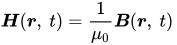
relating the electric displacement field D to the electric field E and the magnetic field or H-field H to the magnetic induction or B-field B. Here r is a spatial location and t is time.

Niciun comentariu:
Trimiteți un comentariu